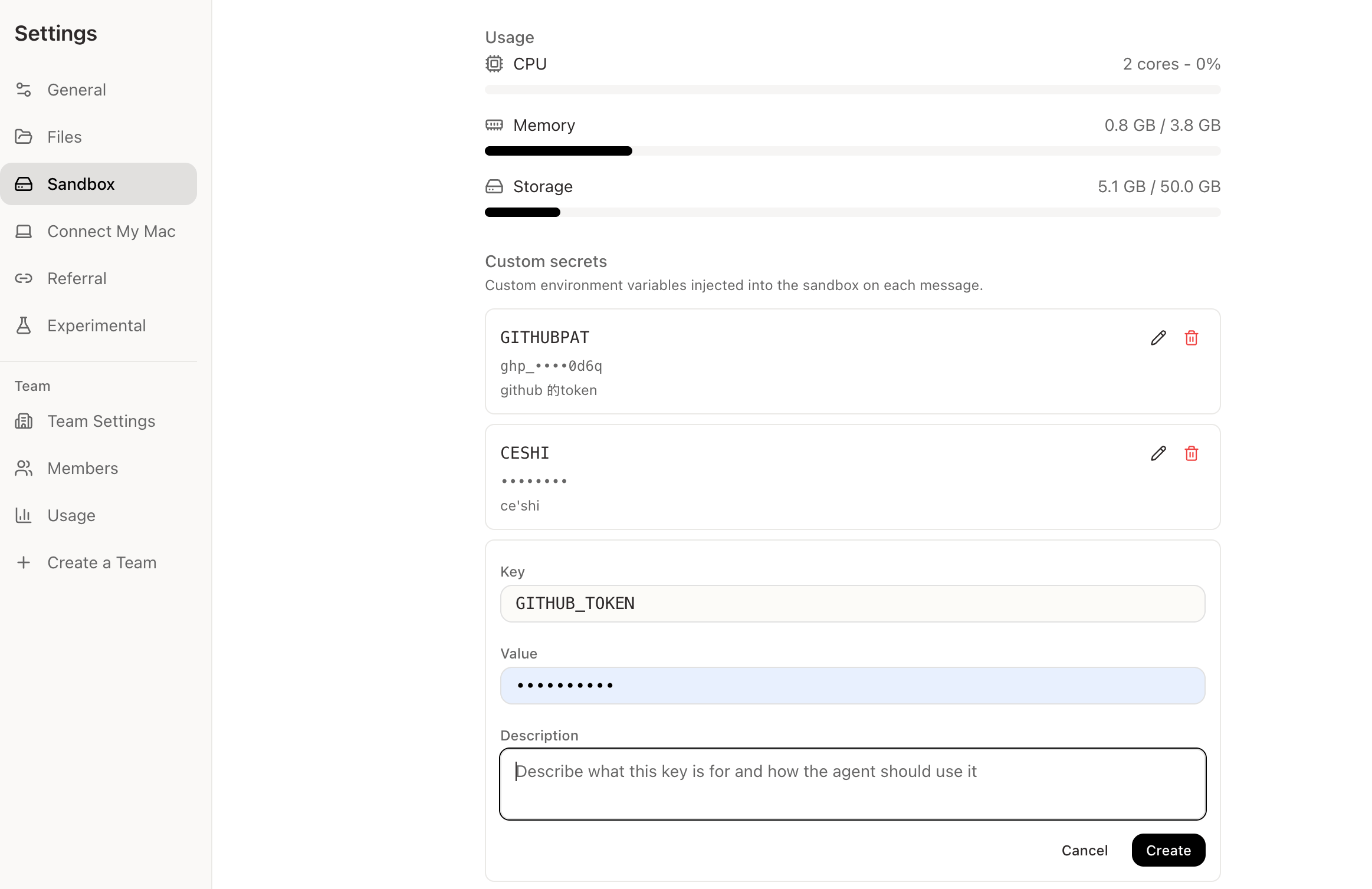

Custom secrets are private access keys for services outside Happycapy, such as GitHub, Notion, Fly.io, Stripe, or your own internal tools. When a tool needs a token or API key, add it in Settings > Sandbox > Custom secrets instead of pasting it into chat. Happycapy injects the secret into the sandbox as an environment variable on each message.

When to Use Custom Secrets

Use custom secrets when Happycapy needs to access a service or tool on your behalf. Common examples include:
  • checking GitHub repositories, pull requests, or workflow runs
  • creating or updating Notion pages
  • deploying or inspecting apps on platforms like Fly.io
  • running scripts that call your own Stripe, analytics, database, or internal APIs
  • using command-line tools that expect credentials from environment variables

Add a Secret

  1. Open Settings.
  2. Go to Sandbox.
  3. Find Custom secrets.
  4. Click Add.
  5. Enter a Key, Value, and Description.
  6. Click Create.
Custom secrets settings in the Happycapy sandbox settings panel

What Each Field Means

Write descriptions as short instructions, not just labels. Good:
Too vague:

Common Examples

These names are examples. Always use the key name expected by the tool, SDK, or CLI you plan to use.

How Happycapy Uses Secrets

After you add a custom secret, you do not need to paste the value into chat. Ask for the task normally.
Happycapy can see that the environment variable exists and can use your description to understand what it is for. Secret values stay hidden in the interface.

Tips

Do not paste private tokens directly into chat. Use clear, standard key names when possible. Tools often look for exact environment variable names. Keep descriptions specific. Mention the service, tool, and intended use. Delete secrets you no longer need. If a tool cannot find a secret, check that the key name matches what the tool expects.
  • CLI tools: use command-line tools that read credentials from environment variables.
  • MCP: connect Happycapy to external tools and systems through MCP servers.
  • Files: manage uploaded files and generated outputs in the sandbox.